Not So Fun: A Claim-by-Claim Review with Documentation
Updated: Jan 9
A Fact Review of the Gowrylow Letter
Before we review each claim in the Gowrylow letter, it’s important to acknowledge something that becomes clear the moment you read it closely:
Many of the letter’s strongest accusations collapse under their own internal contradictions. Not because of anything outside the text — but because the text itself doesn’t hold together.
This brief commentary walks readers through the most striking examples and prepares them for the structured fact review that follows. We are providing the text of the letter as evidence of our statements.

Confusion Between City Law and HOA Law
The letter argues that the City of Olympia will “knowingly issue permits that violate our covenants,” implying a kind of municipal betrayal.
But cities do not enforce private HOA covenants — ever. They can’t. It’s not their jurisdiction.
Basing an entire fear narrative on a misunderstanding of basic governance weakens every conclusion presented.
Emotional Conclusions Treated as Facts
Lines like “covenants be damned” and “the city wants to increase its tax base” are emotional interpretations, not documented evidence.
Sometimes there’s simply a housing shortage, and not everything is a coordinated threat to Ken Lake.
Selective Use of Authority
The letter leans heavily on the authority of an HOA attorney who had a long-standing communication breakdown with the board — to the point of withdrawal.
If the relationship was that unstable, readers deserve more than “the attorney said so.”
If the attorney is unable to work with duly-appointed members of the board, it is unclear why the board would vote to re-hire him.
Slippery-Slope Catastrophes
The leap from “one internal ADU” to “streets lined with cars, packed parks, and loss of single-family identity” is not an argument; it’s a dystopian jump cut.
Governance deserves evidence, not dystopian imagery.
Accusing “Character Assassination” While Performing It
The letter claims moral high ground while delivering two pages of personal condemnation.
This isn’t a neutral warning. It’s a narrative designed to make one neighbor seem fundamentally unsafe.
“Propaganda… motherhood and apple pie”
The letter dismisses Friends of Ken Lake as “propaganda,” yet it is campaign material that offers no citations, no minutes, no documents, and no timelines.
Like, we wrote a website that everyone could agree with, focused on things that brought us together, showed our work and somehow that is wrong, too?
(Happy to share a recipe, though!)
Claims With No Documentation Anywhere Else
The most extreme allegations — such as “opening the parks to the homeless” — appear nowhere in minutes, emails, proposals, or any other public forum.
When a single-source claim is this dramatic, readers should expect supporting documentation. None is provided, and casts a shadow of doubt on every other claim made.
Motive Attribution Without Evidence
Several statements make bold declarations about what someone intended — not what they did. This rhetorical move frequently substitutes for evidence when evidence is lacking.
Why We Highlighted These Statements
The purpose of this section is not to score points — it is to help readers understand why a fact review is necessary in the first place.
The letter relies on:
emotional leaps presented as facts
claims without citations
fear-based predictions
moralized narratives
incorrect assumptions about city vs. HOA authority
accusations unsupported by minutes or documents
Next: The Claim-by-Claim Review
Below is a structured comparison of each assertion in the letter against:
available documents,
meeting minutes,
campaign materials, and
observable communication patterns.
This is not about personalities. It is about accuracy, documentation, and how information was presented to voters.
Claim in Gowrylow Letter | Documented Example by Gowrylow / REAL Friends Group | What the Documents Show |
“Character assassinations, no.” | The letter and flyers signed by Mike contain detailed personal allegations about a single individual. | No comparable public document from any other board member contains personal allegations. |
“He split the community and created an atmosphere of distrust.” | REAL Friends flyers used the label “REAL” to distinguish their slate; campaign materials targeted one neighbor and framed the election as a conflict. | FoKL invited all candidates to a joint forum and used campaign materials to describe values, experience, and policy positions. |
“He charged, without evidence, that some board members were targeting homeowners they didn’t like.” | The letter makes several claims without citing dates, documents, or minutes. | Minutes on KenLake.org show inconsistent compliance practices; concerns about selective enforcement were reasonable topics for discussion. |
“Tell a lie often enough and some people will believe it.” | Certain fears about widespread densification (multiplexes, loss of single-family character) appeared repeatedly in campaign materials, then later shifted. | Public messages in the President’s Corner (Sept & Nov 2025), this letter, and the “REAL Friends” flyer repeated predictions not documented in minutes or policy discussions. |
“He spreads propaganda through a website.” | REAL Friends flyers and letters presented unverified claims without citations and used fear-based framing. A “Save Ken Lake” website later appeared and was removed after the campaign. | FoKL materials present bylaws, minutes, and analyses with citations. FoKL is not written by one person alone, but is a community project that is growing with support. |
“It’s all motherhood and apple pie—who can argue with that? I certainly don’t.” | Public meetings show instances where chat was disabled or residents were muted while others in the same room spoke freely. Additionally, fear-based messaging in this letter is very much not "motherhood and apple pie." It may be true that the author doesn't argue. If that is the case, then actions are not aligned with values. | See minutes involving technology committee recommendations and meeting accessibility concerns. This is community election, and we don't think it's wrong to want the same things for our community. We did add an apple pie recipe to the blog, because we don't want to pass up a good idea. |
“They aren’t inventing anything new, just taking credit for it. It is just a façade.” | The President reversed several housing-related positions after the election, and SaveKenLake.com was scrubbed. | FoKL discusses values openly to help residents understand candidate values and open conversations before voting takes place. |
“while demonizing opponents as fear mongers.” | The letter and aligned flyers use moral and emotional framing to depict one neighbor as unsafe. | FoKL does not name individuals in critiques; articles focus on systemic patterns, including documentation of fear appeals. |
“He told residents we should open our parks to the homeless. Really?” | No, not really. This claim appears only in this letter and flyers, and other media produced by the REAL group; no documentation supports the statement. |
“He tried to create an executive committee led by him that would exclude the rest of the board.” | In 2024, compliance recommendations were developed in a closed setting and brought to the board without full visibility. |
“He ignored or demeaned board members who didn’t share his views.” | The letter itself and affiliated flyers contain dismissive or demeaning language toward specific community members. | Public correspondence and minutes do not show Evan demeaning other directors. |
“He made decisions without consulting the board.” | The president’s handling of Toni’s candidacy occurred without full board consultation. | Minutes do not document unilateral decision-making by Evan. |
“threatening candidates with reprisals.” | Several neighbors reported receiving strongly phrased emails from this author. | Minutes show Evan identifying procedural consequences, not personal reprisals. |
“pushing wild, non-attorney interpretations of our covenants.” | The letter asserts that allowing one ADU would permit unlimited cottages—this extrapolation does not appear in statutes or covenants. | All directors and members may discuss covenant interpretation; baseline ADU law distinguishes accessory units from primary dwellings. |
“He accused me and others of being corrupt and breaking laws.” | The letter accuses one neighbor of misconduct, manipulation, and improper behavior. | Minutes from the Nov 25, 2025 executive session reflect hybrid-meeting irregularities requiring procedural review. |
“This was implied on friendsofkenlake.com until recently removed—a bit of CYA.” | The SaveKenLake.com website was removed after the campaign. | FoKL updates posts for accuracy; no relevant statements were removed to our knowledge. |
“His latest assertion is that our clerk and I are thieves.” | This letter and other flyers use highly charged terms in describing one neighbor’s actions. | The underlying concern related to the use of an organizational email list for non-organizational purposes; this is a data-governance question, not a personal accusation of criminality. |
“Again, he makes such accusations with zero evidence.” | This letter includes numerous allegations without documentation. | We cannot share email addresses, but can share text with identifying information redacted from homeowners who are not and have never been in the directory. The president and clerk directly responded to some of these individuals after the president unilaterally decided to give the concerns directly to the person they were about; a person who was not included when the concern was raised. |
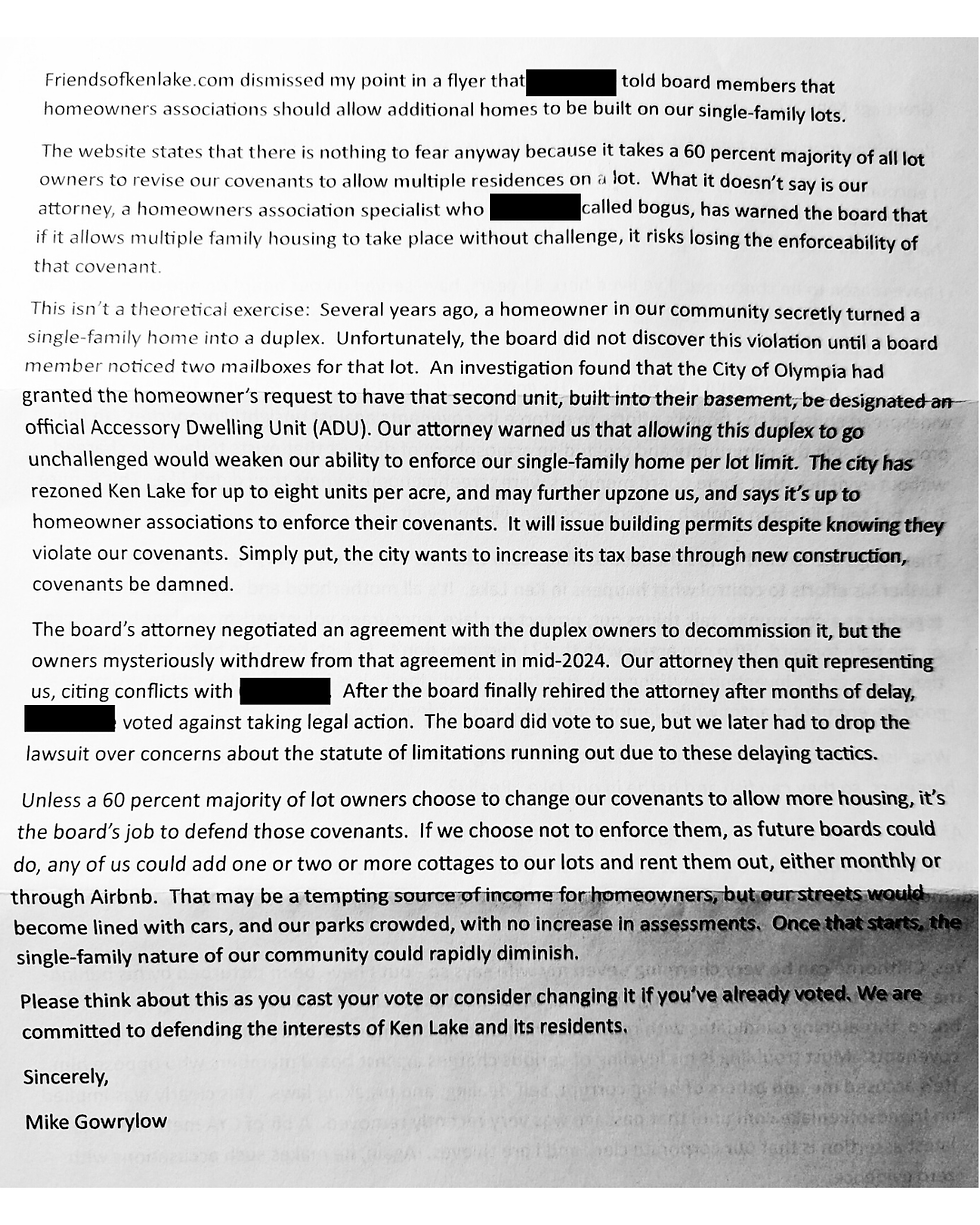
Fixed It For You: The Saga of the ADU
Several years ago, a homeowner created a second living space in a basement for their grown child, who would be residing with them regardless.
The City of Olympia issued a permit for this space and treated it as an Accessory Dwelling Unit (ADU), which is allowed under City law.
The HOA did not immediately identify this as a potential covenant issue because:
the addition was internal,
the visual footprint of the home did not change, and
the City’s permit listed it as an ADU.
Once the HOA discovered the configuration, the attorney advised the board that allowing a duplex-like arrangement without challenge might weaken the HOA’s ability to enforce the one-home-per-lot covenant in the future. This assertion is not supported by current case records.
The ADU was discovered because the homeowner registered a second address for mail delivery.
This step is common for permitted accessory dwelling units and does not convert a property into a duplex or create a second primary residence under Washington law.
A secondary address is an administrative designation, not a zoning change.
The existence of the ADU triggered an enforcement review, but it did not alter the covenant, the single-family designation of the lot, or the HOA’s future ability to enforce the one-home-per-lot covenant.
The board and the homeowner entered discussions about resolution. However, communication eventually stalled, the homeowner withdrew from negotiation while Larson was the president of the board, and the attorney later withdrew from representation due to a breakdown in the relationship between the attorney and the HOA as a whole.
Key clarifications:
No candidate has proposed allowing multiple primary homes per lot.
ADUs and two primary dwellings are legally different things.
The HOA retains covenant enforcement authority whether or not the ADU situation is resolved.
In short:
A specific enforcement challenge occurred.
The situation was complicated but did not threaten single-family zoning in general.
No candidate proposed or supported allowing multi-home development.
The scenario does not justify predictions of densification, traffic doubling, park crowding, or community decline.
This corrected description reflects what the ADU issue actually was—a single enforcement case—not a plan for widespread densification.


Comments